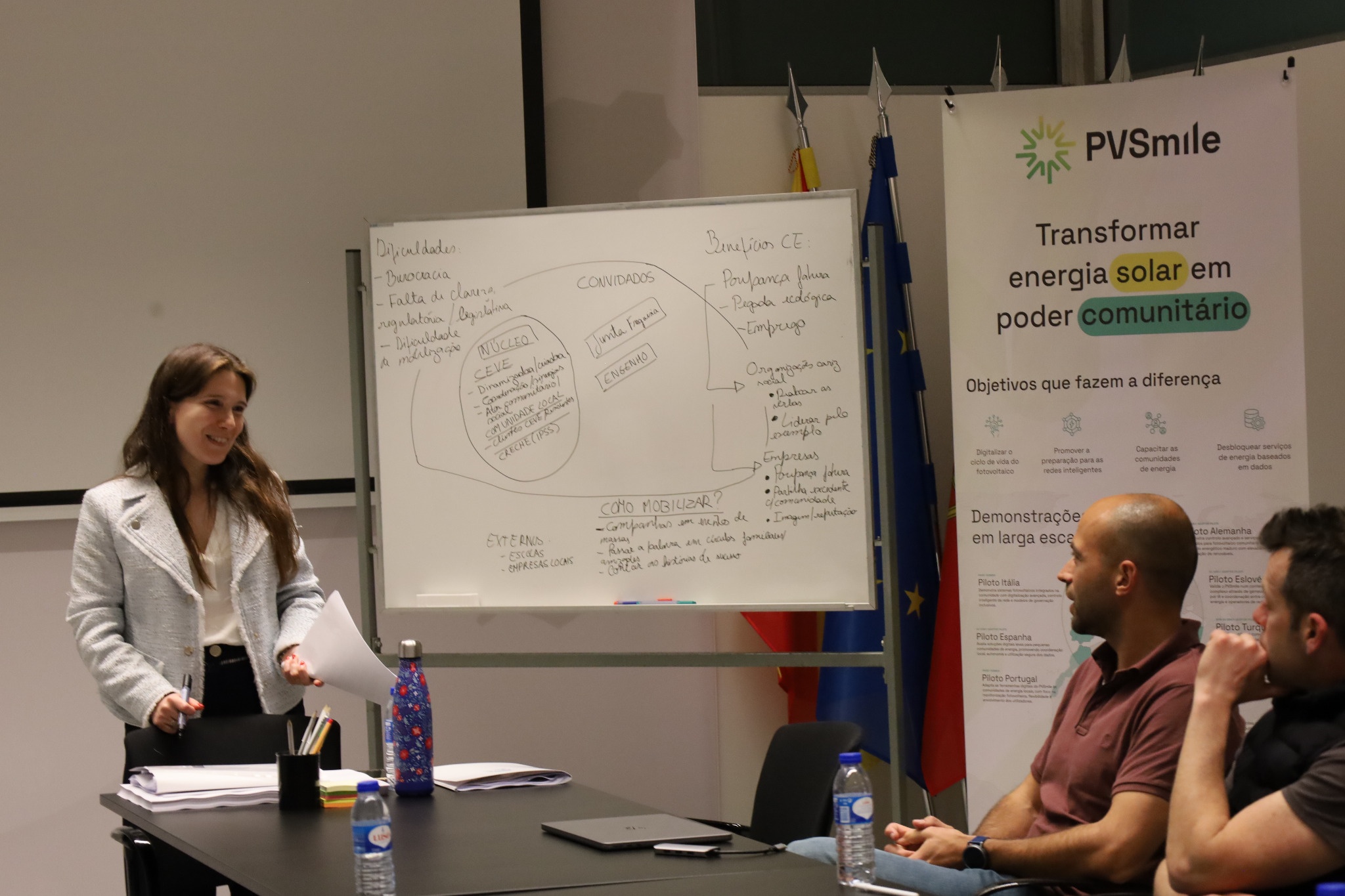
As part of PVSmile’s work on stakeholder mapping and social gap analysis, CEVE – Cooperativa Eléctrica do Vale d’Este, together with Coopérnico – Cooperativa de Desenvolvimento Sustentável, organised a participatory session focused on the Vale d’Este pilot in Portugal.
The activity brought together 18 participants to look beyond the technical dimension of the energy community and examine the people, organisations and relationships that shape it.
The session provided an opportunity to identify the stakeholders already involved in the Vale d’Este pilot, understand their different roles and levels of influence, and consider which actors could become more closely engaged in the future.
Participants included CEVE cooperators, residents, technical actors, community members and project partners. The discussion also considered the potential involvement of a wider range of local stakeholders, including schools, businesses, social organisations and other community-based actors.
This approach reflects the objectives of PVSmile Task 2.1, which focuses on mapping stakeholders, examining relationships and power dynamics, and identifying opportunities for more equitable participation within energy communities.
Looking at who is still missing
A central part of the discussion focused on social inclusion and representation.
Elderly residents and representatives of a local nursery contributed their perspectives, while participants also reflected on groups that remain less represented in the community. These included women, energy-vulnerable households and other citizens who may face barriers to taking part in community energy initiatives.
Identifying these gaps is an important step in understanding not only who currently participates, but also the reasons why some people remain outside the process.
The session also explored practical approaches for reaching a broader range of local stakeholders.
Participants discussed the value of community events, informal communication and word of mouth, as well as closer cooperation with social services and local organisations. Another important element was making the benefits of community energy more tangible and relevant to everyday life.
For citizens, those benefits can include lower energy costs, greater value retained within the local community and a reduced environmental footprint.
From stakeholder mapping to more inclusive energy communities
Stakeholder mapping within PVSmile is not simply an exercise in identifying organisations. It forms part of a broader process of understanding who participates, who holds influence, who benefits and where barriers to inclusion remain.
The insights collected through the Vale d’Este session will contribute to PVSmile’s wider work on social gap analysis and the co-creation of more inclusive solutions for energy communities. The project’s social approach is designed to support participation, equity and the involvement of underrepresented groups in the energy transition.
By bringing local actors together and opening the discussion to voices that may otherwise be overlooked, the Vale d’Este pilot is helping build the foundations for an energy community that is not only technically effective, but also inclusive, locally rooted and responsive to the people it serves.